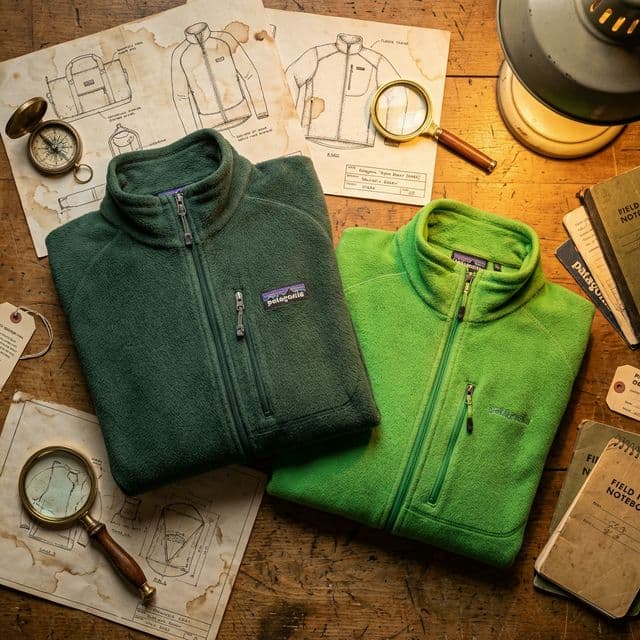
When discussing the engineering legacy of Patagonia, one garment stands above all others: the R2 Jacket, introduced in 1999 as the thermal core of the Regulator System. For over two decades, it became a gold standard for alpine mid-layers.
For backcountry skiers, mountaineers, and gear enthusiasts alike, the R2 was far more than cold-weather insulation. As the classic high-loft R2 disappeared from the line, the R2 TechFace carried the R2 name into a new cross-layer category. Here is a technical dissection of what that iconic, furry fleece achieved, how it evolved, and where its spirit lives on today. This is not merely a nostalgia piece—it is a study in how engineers tried to alpine-proof comfort.
01. From Toilet Seat Covers to High-Loft Fleece
The origin of modern technical fleece is surprisingly gritty. In the 1970s, Yvon Chouinard was searching for a synthetic material that wouldn't absorb water like heavy wool, yet dried almost instantly. The early precursor—polyester pile—was born when Malinda Chouinard stumbled across polyester fabric originally intended for toilet seat covers at a fabric market in Los Angeles.
Partnering with Malden Mills in Massachusetts (now Polartec), Patagonia transformed that humble material into Synchilla in 1985, and eventually into the legendary Regulator Fleece System in 1999.
| Series | Primary Role & Climate Intent | Historic Core Fabric |
|---|---|---|
| R1 (Flash) | High-breathability base / mid-layer | Polartec Power Dry (Grid) |
| R2 (Jacket) | Thermal core / Maximum efficiency | Polartec Thermal Pro (High loft) |
| R3 (Radiant) | Heavyweight sub-zero insulation | Polartec Thermal Pro (High density) |
| R4 (Windproof) | Hybrid windproof shell / insulation | Polartec Windbloc / P.E.F. membrane |
The revolution of the R2 lay in its thermal efficiency and warmth-to-weight ratio. Compared to the heavy 300-weight fleeces common at the turn of the millennium, the R2 delivered superior heat retention with significantly less weight and bulk.
02. The Architecture of Evolution: Decoding the Style Numbers
If you examine vintage R2 jackets, the care tag's Style # reveals how Patagonia's design philosophy sharpened from a relaxed alpine fleece into an uncompromising piece of technical equipment.
1. The Genesis: Pure Thermal Insulation (1999–2003)
Early R2 jackets utilized an all-over Polartec Thermal Pro "monkey hair" high-loft fleece. Models produced between 2001 and 2002 were manufactured in the USA (Made in USA). Characterized by exceptionally robust stitching and minimal side articulation, these vintage US-made pieces continue to command high premiums among collectors. In this era, Patagonia was exploring the purest expression of a wearable blanket.
2. The Golden Balance: The ~2012 Generation (Style #25136)
Widely regarded by long-time users as the peak of alpine comfort, the ~2012 version struck a legendary balance. It retained plush, cloud-like high loft while integrating generous Polartec Power Stretch underarm and side panels. These four-way stretch panels offered incredible mobility and breathability without sacrificing thermal efficiency.
The cut was slightly more forgiving, making it just as versatile for casual daily wear as it was under a hard shell on the skin track. Mountain functionality and urban lifestyle seamlessly coexisted.
3. The Turning Point: Style #25137 (2014–2015)
A critical bridge between plush comfort and specialized breathability. In this generation, Patagonia shifted the side panels, underarms, and lower torso from Power Stretch to R1 Polartec Power Dry high/low grid fabric, prioritizing rapid moisture transport. This generation also introduced discreet on-seam thumb loops and adopted Sonic/Stitch seam construction around the zippers to shave weight and reduce bulk.
4. The Technical Zenith: Style #25138 (Late 2010s)
The late 2010s marked the peak of technical complexity in the R2's evolutionary history. Rather than just side panels, Polartec Power Grid was extended across the underarms, sleeves, and cuffs.
Most notably, Patagonia engineered the iconic Spiral-Seam construction at the cuff, allowing sleeves to be pushed up easily past the forearms without constricting circulation, while sealing snugly at the wrist against draft. Combined with Sonic/Stitch construction throughout, Style #25138 represented the most technical form of the classic high-loft R2.
5. The Final Refinement: Style #25139 (2019–2021)
By 2019, Patagonia refined and simplified the design for its final production run. The complex spiral-seam cuff was transitioned to a streamlined elasticized cuff, and Power Grid fabric was consolidated primarily on the side panels to shed excess heat during high-output activity.
Constructed with Fair Trade Certified sewing and an increased ratio of recycled polyester, Style #25139 completed the journey—a clean, mature distillation before the classic high-loft era came to a close.
| Spec Feature | 2012 Era (#25136) | Technical Zenith (#25138) | Final Refinement (#25139) |
|---|---|---|---|
| Main Body | Polartec Thermal Pro | Polartec Thermal Pro | Polartec Thermal Pro (Recycled) |
| Side / Underarms | Polartec Power Stretch | Polartec Power Grid (Sides, sleeves, cuffs) | Polartec Power Grid (Side panels) |
| Cuff Architecture | Standard stretch binding | Spiral-Seam construction | Elasticized cuffs |
| Fit Profile | Regular Alpine Fit | Athletic Slim Fit | Slim Fit |
| Seam Construction | Standard flatlock | Sonic/Stitch construction | Sonic/Stitch construction |
03. Collector's Field Guide: Style Number Reference
For buyers searching the second-hand market or vintage archives, style numbers are the definitive road map:
- Style #25130 / #25131 (Mid-2000s): Transition era from USA to overseas production; extremely durable, dense pile.
- Style #25136 (Circa 2012): The undisputed classic; Power Stretch side panels and deep, plush loft.
- Style #25137 (2014–2015): Turning point. Introduction of Polartec Power Dry grid side panels and discreet on-seam thumb loops with Sonic/Stitch construction.
- Style #25138 (Late 2010s): Technical Zenith. Power Grid extended to sleeves and underarms; engineered Spiral-Seam cuffs.
- Style #25139 (2019–2021): Final refinement. Streamlined elasticized cuffs, Fair Trade Certified sewing, and classic P-6 woven chest pocket.
04. The Military Offshoot: MARS and PCU Level 3
No technical archive is complete without mentioning MARS (Military Advanced Regulator System), developed by Patagonia for US Special Operations Forces (SOCOM). The PCU Level 3 Fleece was directly derived from the R2 design, finished in tactical colorways like Alpha Green and Coyote. Stripped of civilian brand embroidery to meet field operational requirements, the military and civilian lines shared the same broader Regulator philosophy: high warmth-to-weight, rapid moisture transport, and efficient layering.
05. The Legacy: Where Did the R2 Go?
In 2021, the classic high-loft R2 was retired. Its technical functions have branched in two distinct directions:
- R1 Air & R1 Thermal: The active warmth once handled by the R2 has shifted to lightweight zigzag jacquard fleece (R1 Air) and dense grid knits (R1 Thermal).
- R2 TechFace: By fusing a weather-resistant woven face with a high-loft interior, the TechFace conquered fleece’s historic weakness—wind vulnerability—creating an entirely new category of alpine cross-layer.
Today, traditional high-loft "shaggy" fleece has largely moved to Patagonia’s lifestyle line (such as the Los Gatos series). The mountain-ready technical version remains frozen in time—a testament to a 20-year era of pure mid-layer perfection.
Which Era Should You Hunt For?
- For pure wearable blanket comfort and everyday use: Seek out the 2010–2012 generation (Style #25136) or the final 2019+ P-6 patch generation (Style #25139) in a size up.
- For dedicated winter mountaineering and technical layering: Target the Style #25138 or #25139 in your true size. Its athletic cut traps dead air with excellent thermal efficiency.
Around 2009, gear forums were filled with enthusiasts singing the praises of the R2. While outdoor apparel has since fragmented into micro-specialized synthetics, those who used the R2 during that era still remember the peculiar appeal of that unmistakable high-loft fleece.
Once my kids are grown, I intend to take an old R2 and travel the world again. After all, that’s what technical romance is all about.